Residential School Champions
Explore the digitized scrapbooks:
The Territorial Experimental Ski Training Program (TEST) is often remembered as a breakthrough in northern sport. But its foundation was laid long before the program existed — in Old Crow, where children and teenagers ran, skied, and trained on their own land, supported by a community that believed in them long before any government did. Father Mouchet coached them, but the strength came from the land and the people.
Old Crow proved what Arctic Indigenous Youth were capable of. Then, in 1967, the rest of Canada finally saw it.
1967 — The First Canada Winter Games
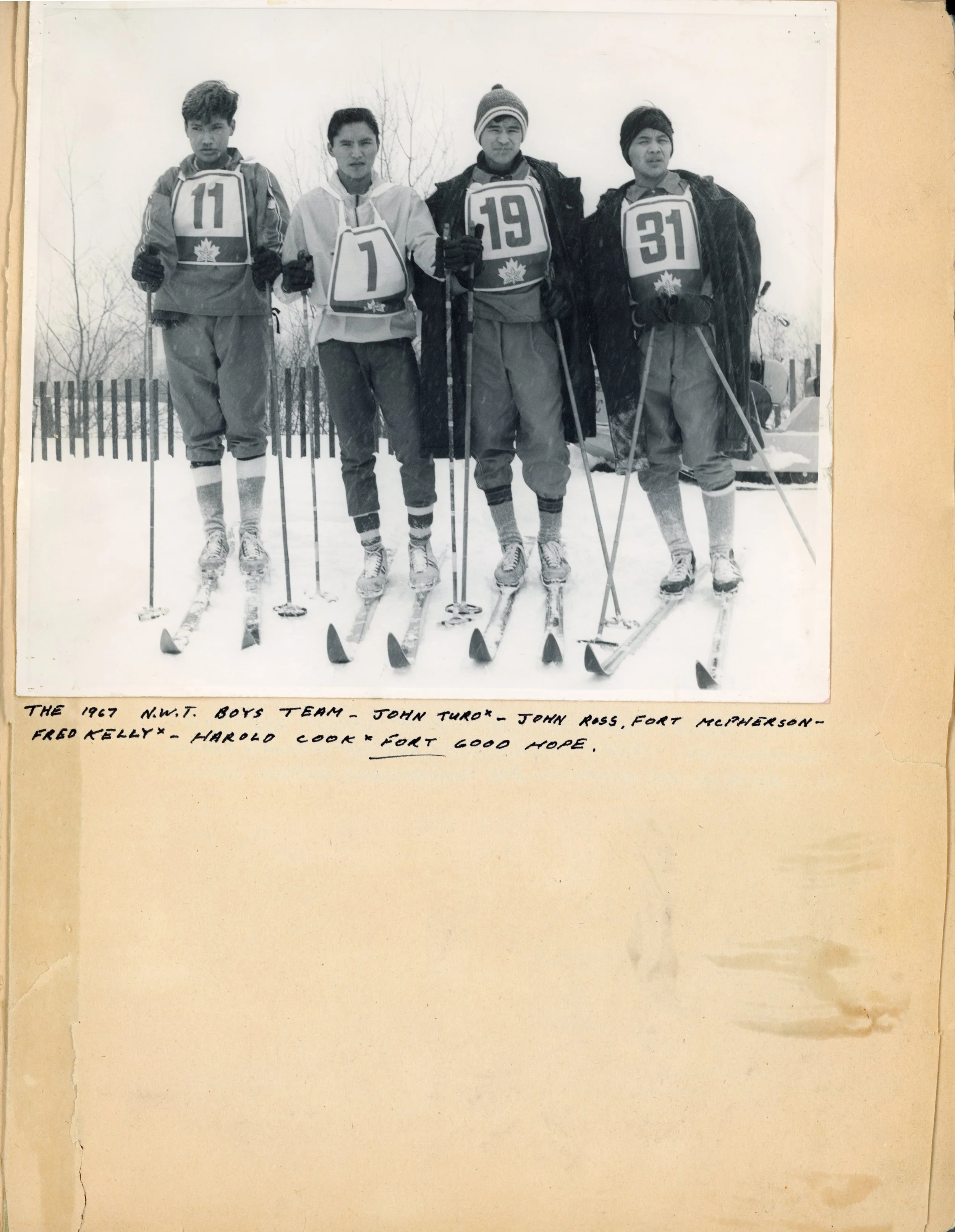
When the first Canada Winter Games were held in Quebec City, the new government town of Inuvik sent a team of residential school students — Gwich’in, Inuvialuit, and Sahtu Dene Youth taken from their home communities and placed in residential school.
They were coached by Father Mouchet. They were far from home. They were teenagers. And they were unstoppable.
The Girls — A Northern Sweep
Janet Tourangeau (Sahtu Dene) — Gold
Eva Tourangeau (Sahtu Dene) — Silver
Anita Allen (Gwich’in/Inuvialuit) — Bronze
Margaret Steen (Inuvialuit) — Top finish
It was one of the most dominant performances in Canadian ski history — and it came from residential school students.
The Boys — The North Arrives
Fred Kelly (Sahtu Dene)
John Turo (Sahtu Dene)
Harold Cook (Sahtu Dene)
John Ross (Gwich’in)
Antoine Mountain (Sahtu Dene)
They raced with determination, placed well, and proved that northern Indigenous Youth were not just competitive — they were contenders.
These teenagers — taken from their families, living under strict and often harmful conditions — became the new powerhouse of junior skiing in Canada.
Their performances announced a truth the rest of the country had never seen before:
Indigenous athletes from the Arctic were not just competitive — they were champions.
The Birth of TEST (1967)
The success of the Inuvik residential school teenagers — combined with a decade of dominance from the Old Crow Skiers — forced the system to respond.
If northern Indigenous Youth could sweep national podiums with almost no resources, what could they do with real coaching and structured training?
To answer that question, the government brought in Bjørger Pettersen, a Norwegian‑trained coach whose philosophy matched the natural endurance and discipline of the Youth.
TEST began in the fall of 1967, after three years of Father Mouchet’s evaluation.
It was created as a development and research project.
TEST Had Clear Objectives
Combine land‑based strength with modern training
Create a pathway to national and Olympic teams
Develop world‑class Indigenous athletes
What TEST Produced
National champions
North American champions
World Championship competitors
Olympians
For the first time in Canadian history, Indigenous Youth from Inuvik became Team Canada — the majority of the national ski team.
Their success was not a miracle. It was investment, coaching, community, and the natural strength of Indigenous Youth.
1972 — Sapporo: When the North Became the Team
Six of Canada’s eight cross‑country skiers came from the North — an achievement unmatched in Canadian sport history.
Roseanne Allen (Gwich’in/Inuvialuit)
Shirley Firth (Gwich’in)
Sharon Firth (Gwich’in)
Roger Allen (Gwich’in/Inuvialuit)
Fred Kelly (Sahtu Dene)
These Youth — many still in residential school — carried Canada onto the world stage.
1976 — The North Returns to the Olympics
Ernie Lennie (Sahtu Dene)
Bert Bullock (Gwich’in)
Sharon Firth (Gwich’in)
Shirley Firth (Gwich’in)
After 1972 and 1976, the Firth twins continued into two more Olympic Games:
1980 Lake Placid
1984 Sarajevo
Four consecutive Olympics — a record unmatched by any Indigenous women in global cross‑country skiing.
Their careers proved that Indigenous excellence was not temporary — it was sustainable, elite, and world‑leading.
And Then — The Support Disappeared
Despite all this success — despite proving Indigenous excellence on the world stage — the program that introduced hundreds of residential school kids to skiing was ended.
The athletes who had given everything, who had represented Canada with pride, who had carried the North onto the world stage, were left with nothing:
No long‑term support
No transition programs
No recognition
No pathway forward
Indigenous excellence was proven — and then the support disappeared.
Want to keep learning about Residential School Champions? Check out the podcast, interviews, and digitized scrapbooks: